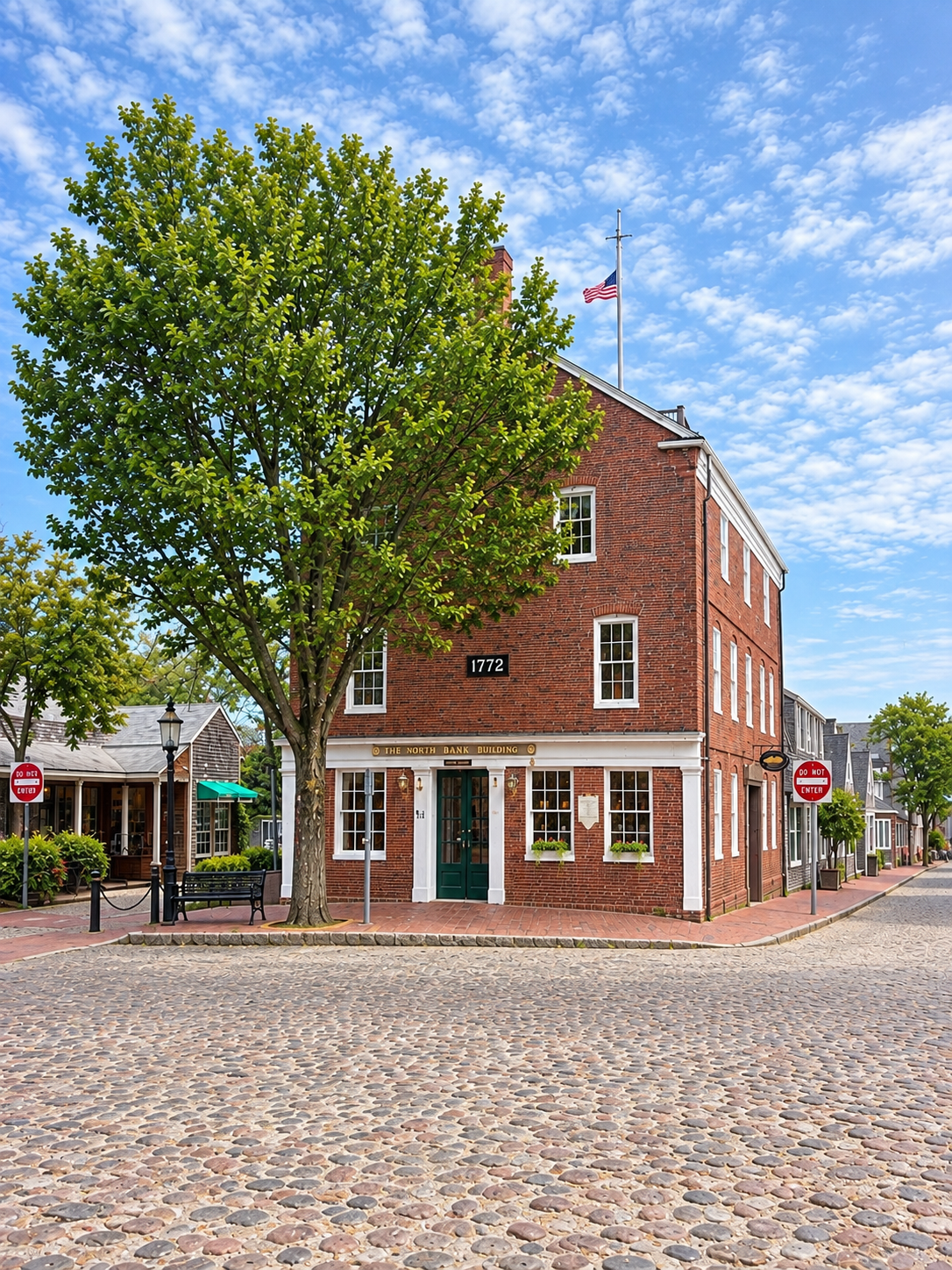

If you have spent any time on Nantucket or following Nantucket this summer you have probably read about the now famous home of the “No Influencers” quarter-board sign hanging at Sylvia’s Antiques. But have you taken a moment to savor the building that houses Sylvia Antiques?
Sitting right at the very foot of Main Street near the harbor, The Pacific Club is one of the most prominent, historic brick buildings on Nantucket.
While visitors pass it every day on their way to the wharves, its history is a fascinating glimpse into the rise and fall of Nantucket’s global dominance in the whaling industry.
1. The Origin: Rotch’s Counting House (1772–1775)
The building was originally constructed by William Rotch, one of the island's most powerful Quaker whaling merchants. It served as his company's counting house (business headquarters) and warehouse.
- The American Flag First: Another one of Rotch's ships operated from here, the Bedford, which became the very first vessel to fly the American flag in a British port when it sailed up the Thames into London in 1783.
2. The Great Fire and The Rebuild (1846)
The building was severely damaged during Nantucket’s catastrophic Great Fire of 1846, which leveled most of the waterfront. Because it was made of brick, the core structure survived. When the town rebuilt, the building’s original colonial gambrel roof was replaced with a full third story and accented with brownstone trim, giving it the grand, stately look it has today.
3. The Captains' Club (1854)
By the mid-1850s, Nantucket’s whaling industry was collapsing due to the California Gold Rush, the rise of kerosene, and a sandbar blocking the harbor. In 1854, a group of 24 retired whaling captains bought the building for $1,200 to use as an exclusive private club.
- They named it the Pacific Club because almost all of them had captained multi-year voyages into the Pacific Ocean.
- The captains used the ground floor to smoke cigars, trade navigation stories, and play cutthroat games of cribbage. A sign on the front of the building still honors three of the island’s most famous historic ships.
4. The U.S. Customs House
For a long time, the building also pulled double duty as Nantucket's federal Customs House and Courtroom. As the shipping industry completely died out, the Customs agent had less and less to do. In the decade leading up to 1913, the collector of customs famously reported that he had collected a grand total of 48 cents in duties. The federal government officially closed the office shortly after.
Current Status
Today, the building is owned by the Town of Nantucket and preserved as an architectural landmark. The interior has been converted into premium commercial and office space, though the exterior stands exactly as it did during the twilight of the whaling era.
Along with the Pacific National Bank at the top of Main Street (named for the same Pacific Ocean wealth), the Pacific Club serves as the architectural bookend to Nantucket's iconic cobblestone downtown.